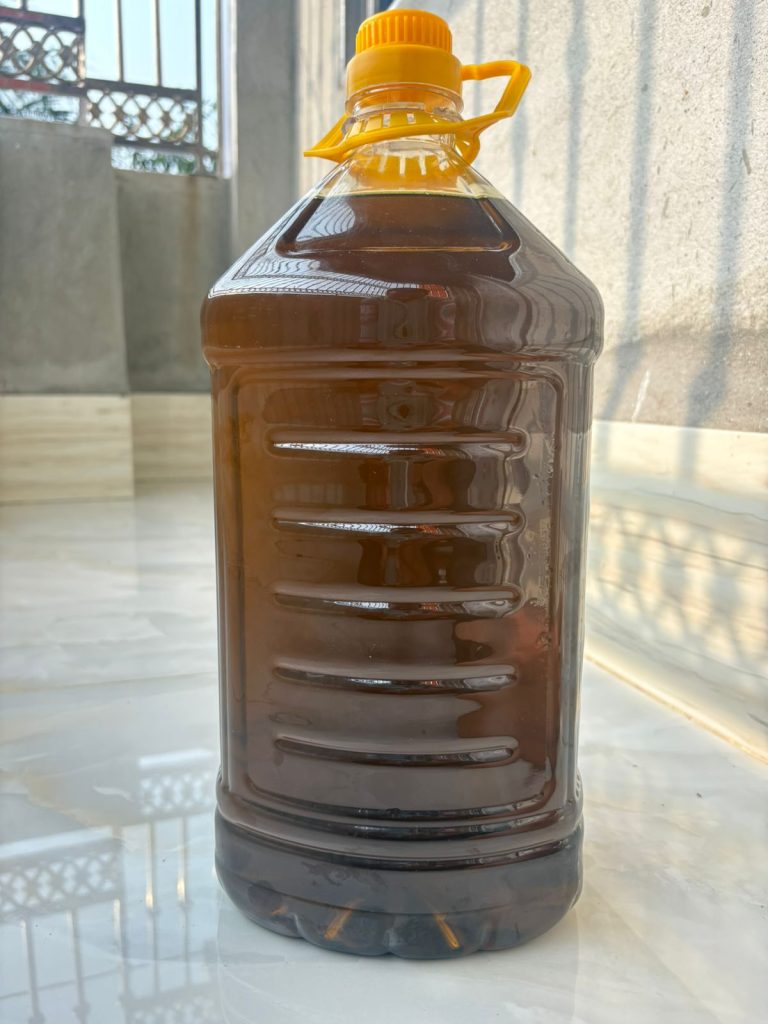
Ghani mustard oil (Bengali: ঘানি ভাঙা সরিষার তেল, ghani bhanga shorishar tel) is mustard oil pressed slowly in a traditional wooden mill called a ghani. Because the press turns slowly, the oil does not heat up much, so it keeps the sharp, nose-tingling aroma that Bengali cooking depends on. It costs more than machine-pressed oil because the same seeds yield less oil. This guide covers how it differs from other mustard oils, what to check before you buy, how it is used, and what it costs in Bangladesh.
Ghani, machine-pressed and refined: the difference
| Wooden ghani | High-speed machine (expeller) | Refined | |
|---|---|---|---|
| Pressing | Slow, low heat | Fast, more heat | Pressed, then processed further |
| Aroma and pungency | Strong | Moderate | Faint |
| Colour | Deep golden to brown | Golden | Pale yellow, very clear |
| Oil from the same seeds | Less | More | More |
| Price | Higher | Lower | Lower |
In India the comparable term is kachi ghani, and in English you will also see wood-pressed or cold-pressed. They all describe the same idea: oil pressed slowly at low temperature without refining.
How to choose a good ghani mustard oil
- Smell it. Open the bottle and the familiar sharp mustard pungency should reach your nose at once. A faint smell suggests refined or blended oil.
- Look at the colour. Ghani oil is usually deep golden. Oil that is very pale and water-clear deserves a question.
- Check the price. A wooden ghani needs roughly 3 kg of seed for a litre of oil, so real ghani oil is never very cheap.
- Ask about the source. Buy from a seller who can tell you where and how the oil was pressed.
- Expect a little sediment. A thin layer at the bottom of the bottle is normal for lightly filtered ghani oil.
A caution: the home tests that circulate online, such as chilling the oil or rubbing it on your palm, cannot reliably detect adulteration. Only a laboratory test can. A trusted source matters more than any kitchen test. The Bengali version of this checklist is here: খাঁটি সরিষার তেল চেনার উপায়.
How Bengali kitchens use mustard oil
- Raw: in bhorta (mashed potato, aubergine or dried fish), jhalmuri and pickles, where the pungency is the flavour.
- Heated until it just smokes: for frying fish and cooking curries, which mellows the raw smell.
- Both: in shorshe ilish (hilsa in mustard sauce), cooked in hot oil and finished with a spoonful of raw oil.
- With chuijhal: Khulna’s beef, mutton and duck curries are traditionally cooked in mustard oil. See the chui jhal beef recipe.
Ghani mustard oil price in Bangladesh (October 2026)
These are the current prices for wood-pressed deshi mustard oil at Sodai Online. Prices move with the mustard season; the product page always shows the latest.
| Size | Price | Per litre |
|---|---|---|
| 1 litre | BDT 380 | BDT 380 |
| 2 litres | BDT 640 | BDT 320 |
| 5 litres | BDT 1,400 | BDT 280 |
| 10 litres | BDT 2,750 | BDT 275 |
The oil is pressed from local mustard seed in a wooden ghani at controlled speed, with no added colour, flavour or chemicals. Delivery is nationwide in Bangladesh with cash on delivery: 1 to 2 days inside Dhaka, 1 to 3 days elsewhere.
How to store it
- Keep it in a cool, dark place, away from the stove and direct sun.
- Close the cap tightly after each use.
- Pour a week’s supply into a small bottle so the large one is opened less often.
- Keep water and wet spoons out of the oil.
Frequently asked questions (সাধারণ প্রশ্ন)
What does ghani mean?
A ghani is a traditional slow-turning wooden oil press. Ghani bhanga mustard oil is oil pressed in one, as opposed to oil from a high-speed machine.
Is ghani mustard oil the same as kachi ghani or cold-pressed oil?
They describe the same idea: mustard oil pressed slowly at low temperature and not refined. Ghani bhanga is the Bangladeshi term, kachi ghani the Indian one.
Why does mustard oil sting the nose?
The pungency comes from a volatile compound, allyl isothiocyanate, released from the mustard seed. Heat drives it off, which is why oil heated until it smokes tastes milder than raw oil.
How much does 1 litre of ghani mustard oil cost in Bangladesh?
At Sodai Online, BDT 380 per litre in October 2026. Larger bottles work out cheaper: BDT 280 per litre in the 5 litre size and BDT 275 in the 10 litre size.
Why is ghani mustard oil more expensive?
A slow wooden press extracts less oil from the same seeds than a high-speed machine, and takes longer. More seed and more time per litre mean a higher price.